Pre-launch · Promotional price
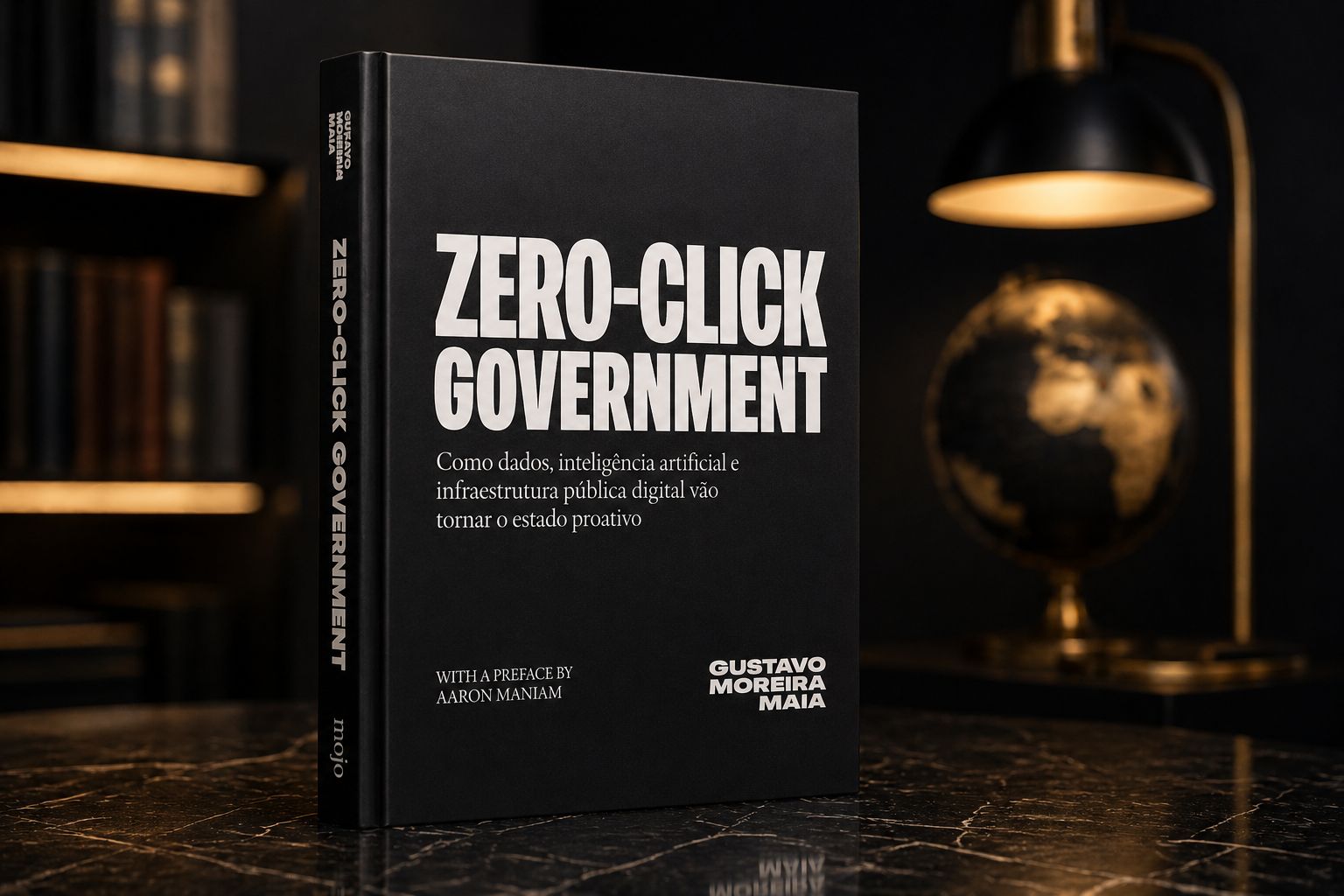
Zero-Click Government
How data, artificial intelligence and digital public infrastructure will make the state proactive.
For decades, governments were organized around a simple idea: citizens ask, the state responds. That model is exhausted.
Zero-Click Government is the first book to propose, in depth, a new grammar for the 21st-century state: stop waiting for the request and start recognizing life events, combining data, AI and digital public infrastructure to deliver rights before citizens have to seek them.
A book written from the Global South, for anyone who still believes governments can make sense again in people's concrete lives.
Pre-launch with a promotional price. Books are in stock and ship immediately, directly from Mojo's store in Brazil.
- 8
- Parts
- 31
- Chapters
- Now
- Shipping
“The contemporary state, even when far along in digitization, is in motion — yet still almost always arrives late. Its failure lies not in the absence of institutional capacity nor in pure omission, but inside an environment of continuous, organized activity.”
Excerpt from Chapter I, Zero-Click Government
Inside the book
Eight parts, thirty-one chapters, one thesis.
- I
Why the state fails even when it digitizes
The exhaustion of the form-based government, reactivity as a producer of inequality, and the gap between administrative time and life's time.
- II
What it means for the state to work well in the 21st century
Public value, state capacity and Mark Moore's strategic triangle applied to the digital era.
- III
Coordination is an attribute of the state, not of software
Digital public infrastructure (DPI) as foundation, typology and maturity roadmap.
- IV
Coordination as a contest of power
The political economy of DPI, public financing and federalism as structural friction.
- V
The new legitimate unit of state action
From request to life event: how to reorganize administration around what actually happens to people.
- VI
Expanded capacity, expanded responsibility
Artificial intelligence, automated decision-making and the agentic state as new institutional design.
- VII
The limits of anticipation
Governance, risk, personal data, the sense of intrusion, and democratic trust as a scarce asset.
- VIII
From thesis to public decision
The Global South as a laboratory, from idea to implementation, and Zero-Click Government as a strategic orientation.
Afterword · A response to the book
Beth Simone Noveck on Zero-Click Government.
Deputy CTO of the White House under President Barack Obama and professor at Northeastern University, Beth writes the book's afterword and published, on Reboot Democracy, a generous yet critical reading of the anticipatory-government thesis.
“The safeguards that matter most are those that prevent anticipatory government from becoming a kitchen where the citizen never sees the menu.”
Pre-launch · Promotional price
The future of the state will not wait for your request.
The book is in pre-launch, with a promotional price for a limited time. Copies are in stock and ship immediately, directly from Mojo's store.